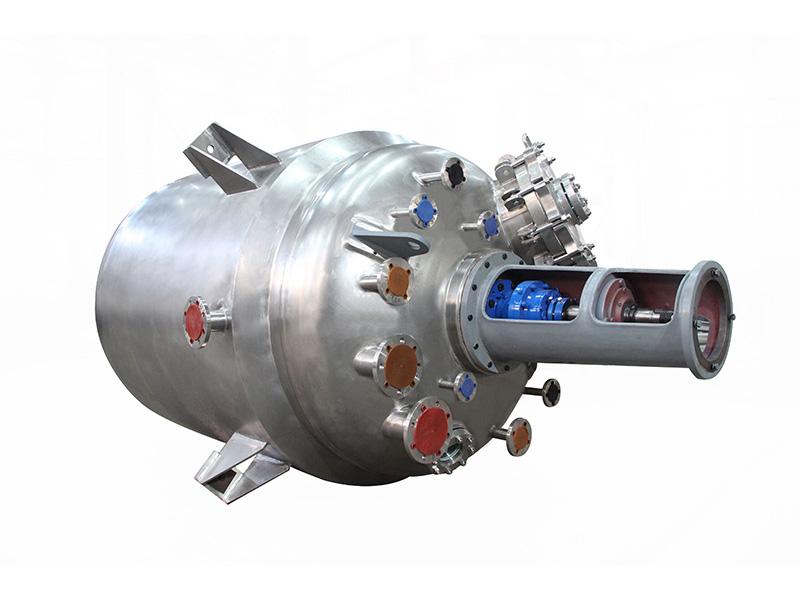


The types of agitators used in stainless steel and carbon steel reaction vessels vary, and the selection is mainly based on material characteristics, process requirements, and mixing objectives. Common agitator types include paddle agitators, turbine agitators, propeller agitators, anchor agitators, frame agitators, and ribbon agitators. Paddle agitators have a simple structure, typically consisting of two or four straight or curved blades, and are suitable for mixing and heat transfer processes of low-viscosity liquids. They offer moderate stirring intensity and can generate radial flow, but their mixing effect on high-viscosity materials is limited. Turbine agitators consist of multiple blades, shaped similarly to the impeller of a centrifugal pump, and can generate strong shear forces and turbulence. They are suitable for applications requiring high shear forces and rapid dispersion, such as solid-liquid suspension and gas dispersion. Turbine agitators are generally divided into open and closed types; open turbine agitators are suitable for general mixing, while closed turbine agitators are suitable for high-viscosity materials.
Propeller agitators typically consist of two or three propeller blades and can generate strong axial flow, suitable for mixing and circulating large volumes of low-viscosity liquids. Propeller agitators are characterized by low energy consumption and high mixing efficiency, and are often used in applications requiring rapid and uniform mixing, such as heat and mass transfer processes in reactors. Anchor agitators are shaped to match the bottom contour of the reaction vessel, allowing them to adhere closely to the vessel walls and bottom during mixing, making them suitable for mixing and heat transfer of high-viscosity materials. Anchor agitators effectively eliminate dead zones on the vessel walls and bottom, preventing material sedimentation and scaling, and are commonly used in polymerization reactions and mixing of high-viscosity materials. Frame agitators are a variation of anchor agitators, typically adding transverse connecting rods to further enhance the mixing effect, and are suitable for mixing extremely high-viscosity materials.
Ribbon agitators consist of helical ribbon blades that generate strong axial and radial flow, suitable for mixing and heat transfer of extremely high-viscosity materials. Ribbon agitators are characterized by good mixing uniformity and effectively prevent material stratification and sedimentation, and are commonly used in reactions and mixing processes of high-viscosity materials. In addition, there are some special types of agitators, such as sawtooth agitators and dispersion disc agitators, suitable for specific process requirements. Serrated agitators, with their serrated blade edges, enhance shearing performance and are suitable for dispersion and emulsification processes requiring high shear forces. Dispersion disc agitators, on the other hand, generate strong shear forces through a high-speed rotating disc, making them suitable for dispersing nanomaterials and mixing high-viscosity materials. The selection of agitator blades requires comprehensive consideration of the material's viscosity, density, corrosiveness, mixing objectives, as well as the reactor's structure and operating conditions, to ensure optimal mixing and process efficiency.
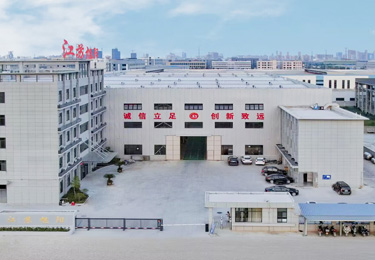
The company is located in the south park of Jingjiang Economic and Technological Development Zone, with superior geographical location and convenient transportation.


Contact:Sang Yuanliang
Tel:13338894168